A hardware dukandar on Lahore's Hall Road told me he'd downloaded QuickBooks, spent two evenings watching YouTube tutorials in English, and then quietly went back to his bahi-khata. The software wasn't broken. It just wasn't built for how he actually runs his shop — cash in the drawer, half the customers on udhaar, and the internet dropping every time the bijli went.
That gap is why people keep searching for a QuickBooks alternative in Pakistan. Not because QuickBooks is bad accounting software. Because it was designed for an American small business with a card on file, steady broadband, and an accountant who's comfortable with words like "chart of accounts."
Let's be honest about what fits a Pakistani dukan and what doesn't.
Why QuickBooks feels wrong for a Pakistani shop
Start with the money. QuickBooks Online runs on a subscription, billed to a card, and the price climbs with the dollar rate. The plan that actually includes inventory costs more per month than a lot of shopkeepers spend on chai for the shop. And every month, whether it was a good month or a dead one, that fee gets cut — har mahine paise kat-te rehte hain. For a karyana store working on thin margins, paying for software you're still learning is a hard sell.
Then there's the internet problem, which is worse. QuickBooks Online is cloud-first. When the connection is patchy — or the power's out and the router's dead — you can't bill a customer. In a Karachi Saddar mobile market during a long load-shedding stretch, that means kaam ruk jata hai. The line stops moving.
And ask a QuickBooks screen where Rafiq bhai's udhaar sits, and it has no real answer for you. There's no built-in khata the way a dukandar thinks about it — "isko itna lena hai, supplier ko itna dena hai." The interface is English, the workflows are Western, and something like item-level expiry on a medical store's stock isn't how it's set up to think.
None of this makes QuickBooks a scam. It's a serious tool, aimed at a different shopkeeper in a different country.
What a Pakistan-first alternative should do
If you're replacing a paper bahi-khata — the kaccha-pakka register most of us keep — and a calculator, the software has to earn its place by being simpler than the paper, not harder.
That means it has to work when the internet doesn't, and sync on its own once it's back. It has to track udhaar per party the way you already keep hisaab, so you can glance at any name and know the lena-dena in a second. And the selling screen has to be fast enough that a cashier bills a customer in a few seconds on a busy evening, no training course required.
Underneath all that, the accounting still has to be correct — proper double-entry, so your profit and party reports actually add up. The shopkeeper never sees it, and that's the point.
The one thing vendors underplay: it should cost nothing you have to think about every month. A dukandar who distrusts monthly fees isn't being cheap. They've been burned by apps that lock the data or start pushing loans.
Sauda vs QuickBooks: an honest comparison
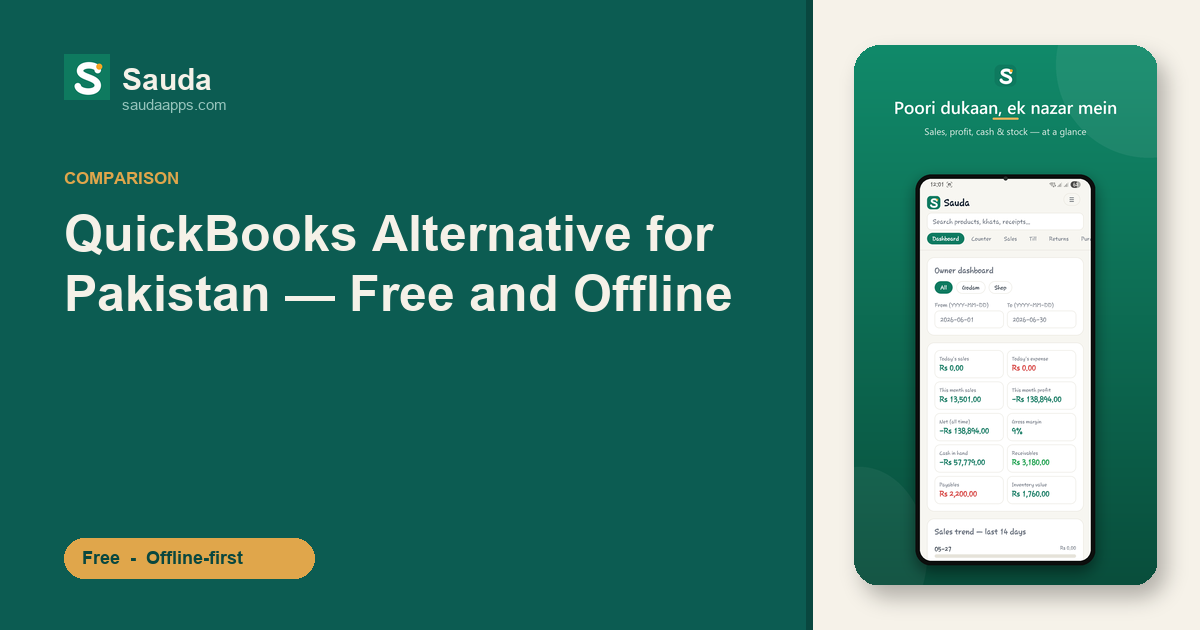
Sauda is a free, offline-first shop app built specifically for Pakistan. Here's where each tool actually lands.
| Sauda | QuickBooks Online | |
|---|---|---|
| Price | Free forever, no card | Paid monthly subscription |
| Works offline | Yes, offline-first with auto-sync | Cloud-first, needs internet |
| Language | Urdu / Roman-Urdu, English toggle | English |
| Khata / udhaar (lena-dena) | Built in, party ledgers | Not a native concept |
| POS billing + barcode | Yes, auto EAN-13 generation | Add-ons / third party |
| Inventory across shops & godams | Yes, with low-stock + item-level expiry alerts | Inventory on higher plans |
| Double-entry accounting | Yes, under the hood | Yes, its core strength |
| Multi-user roles | Owner, manager, cashier, accountant | Depends on plan |
| Runs on | Android, web, Windows desktop | Web, mobile app |
| Payroll | Basic | Full-featured (paid, US-focused) |
| Sales tax | Off by default, optional fields | Full tax handling (built for other markets) |
Where QuickBooks is genuinely stronger: deep financial reporting, mature payroll, and tax handling for businesses that need heavy compliance features. If you're a large firm with an in-house accountant and a real tax workflow, that depth counts for something.
Where Sauda wins for the average dukandar: it's free, it works when the internet doesn't, it keeps your khata and udhaar the way you already do, and the whole thing is in Urdu. You get POS billing, inventory, roznamcha, and profit reports without a subscription or a card.
One thing to be clear about: Sauda does not do FBR or sales-tax fiscalization, batch/lot tracking, or a pre-loaded medicine database. Tax is off by default — the fields are there if you ever switch it on, but nothing forces it. If your business truly needs formal tax integration, that's a real difference to weigh.
Who should switch, and who shouldn't
Switch if you run a karyana store, a hardware shop, a cloth business in Faisalabad or Lahore's Azam Cloth Market, a mobile and electronics counter, a medical store, or a wholesale setup — anyone who mostly deals in cash and udhaar and wants the paper khata off the desk. Sauda was built for exactly this.
Think harder if you're filing formal taxes that need fiscalization software, or you depend on advanced batch tracking. Sauda doesn't cover those today, and pretending otherwise would waste your time.
For most Pakistani shopkeepers, the honest answer is simple: a free, offline, Urdu app that mirrors the bahi-khata beats a paid, online, English one you'll stop opening by the third week.
Try Sauda free — download it for Android, web, or Windows. No subscription, no card, and your data stays yours.
FAQ
Is there a truly free QuickBooks alternative in Pakistan?
Yes. Sauda is free forever — no subscription, no card. It covers POS billing, khata/udhaar, inventory, and double-entry accounting for Pakistani shops.
Does Sauda work without internet?
It's offline-first, so this is the whole point. You can bill, record udhaar, and update stock with zero connectivity — jab bijli chali jaye tab bhi kaam chalta rehta hai. When the internet returns, it syncs on its own across your devices.
Can I use it in Urdu?
The interface defaults to Urdu / Roman-Urdu, with an English toggle if you want it. Words like lena, dena, khata, and roznamcha show up the way a dukandar actually talks, not translated into stiff English.
Does Sauda handle sales tax and FBR?
Tax is off by default. Optional sales-tax fields exist if you choose to turn them on, but Sauda does not do FBR fiscalization or formal tax integration. If your shop needs that, weigh it carefully before switching.
Will my data get locked in or used to push loans?
No — and this matters. Sauda doesn't push loans or wallets, and your shop's hisaab stays yours across Android, web, and Windows with automatic sync.