Aslam runs a karyana store off Faisalabad's Jhang Road. Every night he writes the day's sales in one column of his bahi-khata, what he paid the distributor in another. Cash sale, udhaar sale, a customer clearing old dena, ghee stock that came in on credit. By 11pm the numbers rarely match the cash box. Somewhere a hundred rupay slipped through a crack he can't see.
That gap is exactly the problem double-entry accounting was built to close: not to make life fancy, but to make the shop's story tie out.
What "double-entry" actually means
Single-entry is what most dukandars already do: one line per transaction. Sold rice for Rs 2,000, write 2,000. Simple, but it only tells half the truth. Money came in, sure. Where did it go, and what did it actually cost you?
Double-entry says every transaction touches the shop in two places at once, and both sides must stay equal. Sell a bag of atta for Rs 1,500 cash, when that bag cost Rs 1,200:
- Cash goes up by Rs 1,500, and sales income goes up by Rs 1,500.
- Atta stock goes down by Rs 1,200, booked as the cost of that sale.
Debits on one side, credits on the other, always equal. If they don't match, something's wrong, and you catch it that night, not at year-end.
This isn't a foreign invention either. Your bahi-khata already has a lena side and a dena side. Double-entry is the same instinct, just made consistent.
The roznamcha: your day book, done right
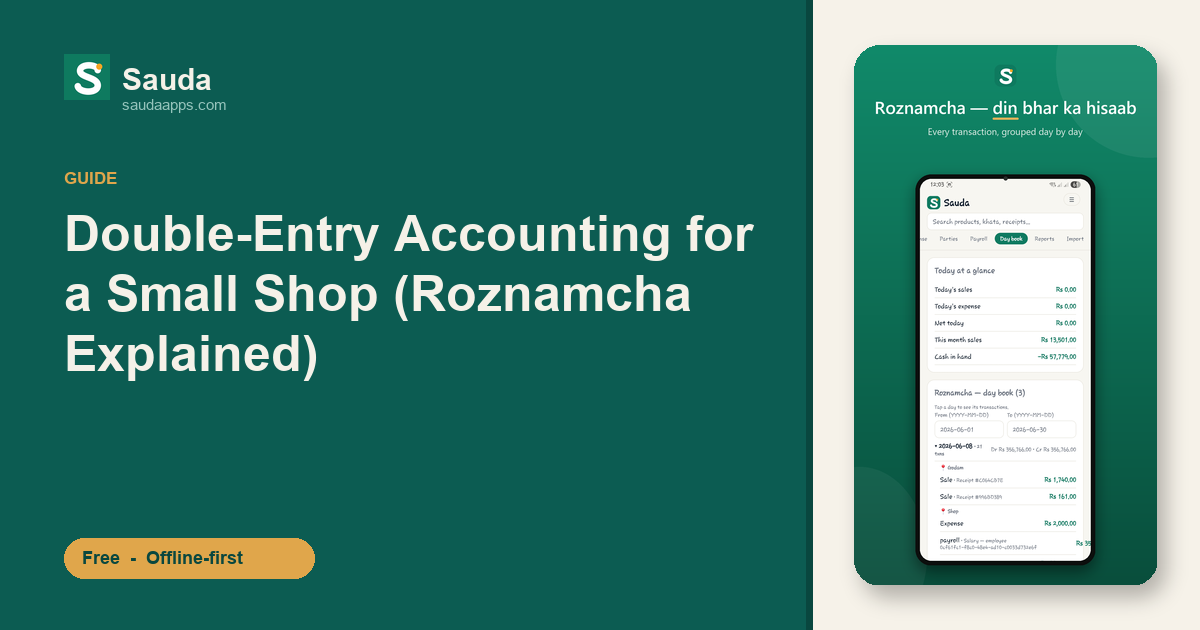
Roznamcha is the day book: the running diary of every transaction, in order, the moment it happens. Cash sales, udhaar given, a supplier paid, salary handed to a helper. From that one feed, proper accounting fans out into party khatas, stock, and your profit number.
The old way, you write the roznamcha by hand, then re-copy figures into the customer's khata, then a stock register, then try to add up profit at month-end. Same number written four times, four chances to fumble it.
Software collapses that. Record the sale once, and the party's khata and udhaar ledger updates, stock drops, and the day book and profit report move with it.
What this looks like in a real shop
Say a cloth trader in Karachi Saddar sells 12 meters of fabric for Rs 4,800, half cash and half udhaar. That fabric cost him Rs 3,600.
| What happened | Goes up (debit) | Goes down / owed (credit) |
|---|---|---|
| Rs 2,400 cash taken | Cash drawer +2,400 | Sales income +4,800 |
| Rs 2,400 on udhaar | Customer's account (lena) +2,400 | |
| Fabric left the shelf | Cost of goods sold +3,600 | Inventory −3,600 |
The debit and credit columns land on the same figure. That's the whole game. When books balance like this, closing cash matches the drawer, stock on paper matches the shelf, and the customer's dena is never in dispute, because it was written the second the sale happened.
Do you really need it?
Honest answer: a tiny stall selling only cash, no udhaar, no stock to track, can limp along on single-entry for years. The moment you're carrying Rs 40,000–50,000 in customer credit across a dozen parties, holding stock across a dukan and a godam, or splitting munafa with a hissa-daar, single-entry starts lying to you. You feel busy but can't say if you're earning. And when a partner asks for his share, or a customer swears he already paid, a shaky book turns into an argument.
Double-entry accounting for a small shop isn't about becoming a chartered accountant. It's about answering three questions any night: how much cash should I have, who owes me what, and did I make money today.
Sauda runs this quietly under a dead-simple selling screen. Bill a customer the normal way, and the postings, roznamcha, party khatas, and profit and stock reports build themselves from that one sale. It works fully offline, so load-shedding never stops a sale, and syncs across phone, counter PC, and web once the internet returns. Free, no card needed, in Urdu or Roman-Urdu with an English toggle.
Download Sauda free and let your roznamcha keep itself. (saudaapps.com)
FAQ
Is double-entry accounting too complicated for a small dukan?
The concept sounds heavy, the daily work isn't. You record each sale or payment once, same as now. The two-sided bookkeeping happens behind the scenes; Sauda's day book and reports do the balancing.
What is the difference between roznamcha and khata?
A khata is one party's running ledger: only their lena-dena, in one place. The roznamcha sits above all of them: the full day's transactions in order, feeding every party's khata as entries happen.
Can I keep double-entry accounts offline?
Yes. Sauda writes every entry to the device first and works with zero internet, then syncs automatically once you're back online.
Does this handle sales tax or FBR filing?
Tax stays off by default, built for shopkeepers who don't file, though optional sales-tax fields exist if needed. It does not do FBR fiscalization or automatic tax filing.
Will I lose my data if I switch phones?
No. Books sync to a central copy, so a new phone, the desktop app, or web all show the same khatas and roznamcha once you sign in.