A customer walks into your hardware shop and asks for 12 feet of 3-core wire, four half-inch elbows, one liter of enamel paint, and a bag of screws he swears he bought last month "on udhaar." You cut the wire, count the elbows, and now you're standing there with a pencil trying to add it all up while three more men crowd the counter. Meanwhile the paint tin at the back has been sitting so long the shade is discontinued, and you have no idea how many elbows are actually left on the rack.
This is the real job. Not "inventory management." Just billing fast and knowing what you have and who owes you.
Why a hardware shop needs more than a calculator
Hardware is a brutal category to track by hand. You sell by piece, by foot, by kilo, by liter. One customer buys a single washer; the next buys 50 meters of PVC pipe and a full carton of tiles. Prices shift with the dollar and with your supplier's mood. And half your good customers run on udhaar, so the sale isn't really finished when they walk out the door.
A paper bahi-khata handles the udhaar part, sort of, until the page gets torn or you forget to write down the Rs 4,300 Bashir sahib took on Thursday. Stock? Most shopkeepers just "know" by looking at the shelf, until the day a wholesaler on Lahore's Hall Road or in Karachi's Sher Shah offers a good rate on cable and you can't remember whether you're overstocked or empty.
Good hardware store billing software fixes both problems at once. You bill in seconds, and every bill quietly updates your stock and your customer's ledger in the background.
What Sauda actually does for a hardware counter
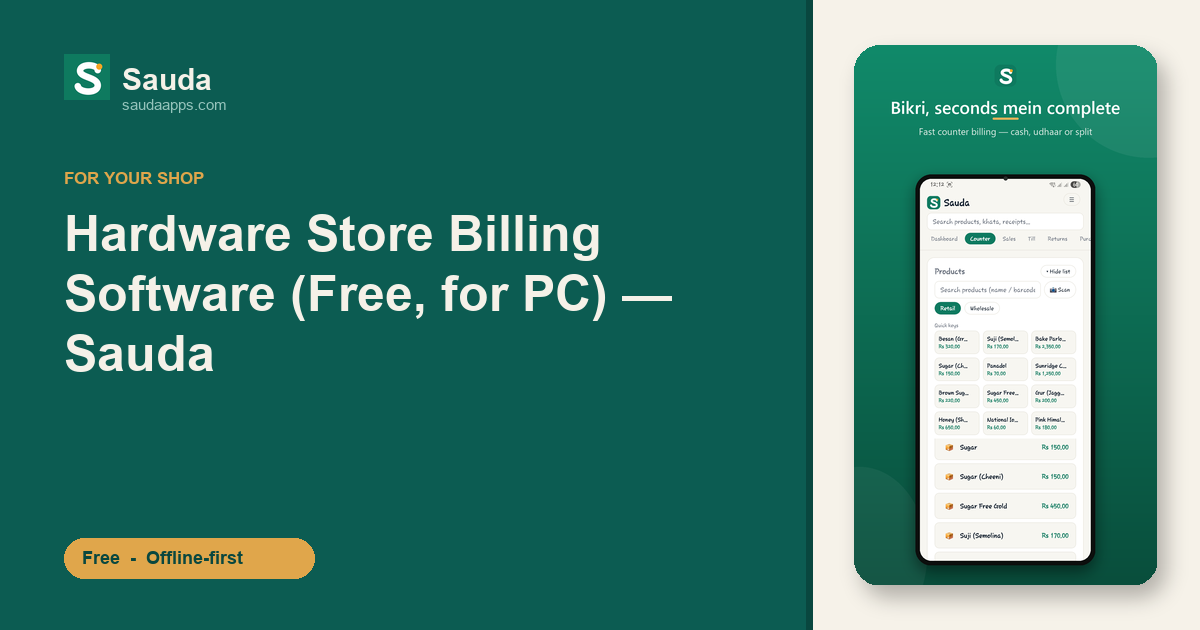
Sauda is free. Not free-trial, not free-for-three-months. Free forever, no card, no subscription. It runs on your counter PC (Windows), on Android, and in a browser, and it syncs between them automatically. Add a sale on the shop laptop, check it on your phone at home. When the light goes and the internet drops during load-shedding, it keeps working offline and catches up later.
Here's what matters day to day.
- Fast billing with barcodes. Scan a boxed item, or for loose hardware that has no barcode, Sauda generates its own EAN-13 so you can label bins and shelves yourself. Ring up mixed quantities without doing sums in your head.
- Udhaar that doesn't get lost. Every party gets a khata showing exactly what's lena and what's dena. Bashir sahib's Rs 4,300 is on his page whether you wrote it by hand or not, because the bill put it there.
Stock is tracked across your shop and any godam (warehouse) you keep. If you store pipe and cement separately, or run a second shop, Sauda counts each location on its own. Low-stock alerts warn you before something runs out, so when PVC pipe drops under 20 meters you hear about it before a customer does, not after.
And the numbers reconcile. There's a roznamcha day book, profit reports, and party statements, with proper double-entry accounting running underneath. You don't have to think about the accounting. You just see the day's hisaab.
It's in Urdu and Roman-Urdu, with an English toggle if your accountant prefers it. Sales tax is off by default, so the selling screen stays clean unless you deliberately turn it on.
What it won't pretend to do
Straight talk: Sauda doesn't do batch or lot tracking, and it isn't a fiscal or FBR-integrated system. If your trade genuinely needs those, this isn't the tool. For a normal hardware, sanitary, electrical, or paint shop that mostly needs fast billing, clean udhaar, and stock you can trust, it's built exactly for you.
Getting started tonight
You don't need to migrate ten years of records to begin. Open Sauda on your PC, add the twenty or thirty items you sell most, and start billing tomorrow morning. The stock counts and khata build themselves as you go. Add the rest of your catalog on a slow afternoon.
Most hardware shops already run the whole day on a diary and a calculator. This just makes that faster and stops the diary from lying to you about who paid and what's left on the rack.
Download Sauda free and put your bahi-khata away for good.