It's 6 in the evening on Hall Road, Lahore. The mobile-accessory wholesaler has three customers waiting, the light just went, and his laptop with the "paid" billing software is now a dead screen. So he goes back to the parchi book and a pen. Half those bills never make it into any hisaab.
This is the real test for any billing app here. Not the fancy dashboard. What happens when the bijli goes and the internet drops in the same minute?
Why most invoice software fails a Pakistani dukan
Most tools sold here were built for somewhere else. They assume a steady connection, a monthly card payment, and a shopkeeper who never sells on udhaar. None of that matches a karyana store in Faisalabad or a medical store in Karachi Saddar.
Then the bill lands. A "free trial" turns into Rs 2,000 or Rs 3,000 a month. Miss a payment and your own sales data gets locked behind a paywall. For a dukan running on thin margins, that's a real trap, and owners are right to be suspicious of it.
The honest requirements are simple. Make a bill in a few seconds. Keep working when the connection dies. Track who owes you money. And don't charge a fee that eats the day's profit.
What Sauda does differently
Sauda is free invoice software for Pakistan that runs fully offline, first. Every bill is saved on your own device the moment you tap done. Load-shedding, dead signal, a phone on 4G in the back godam. It keeps writing. When the internet comes back, it syncs on its own, quietly, in the background.
You can run it on an Android phone at the counter, on a Windows PC in the back office, and on the web from home. Same data, kept in step across all three. Your cashier bills on the phone while you check the day's roznamcha on the laptop.
Billing is fast. Scan a Surf Excel pack, punch qty 2, tap done. That's the whole bill. If a product has no barcode, Sauda generates a valid internal one for you, so even loose karyana items get scanned instead of typed.
Bills and udhaar in one place
Most shopkeepers keep two separate worlds. Cash bills in the machine, udhaar in a bahi-khata on the shelf. The two never quite agree, and month-end turns into a headache of matching one against the other.
Sauda joins them. A cash sale and a credit sale sit on the same screen. Say Rashid takes Rs 4,500 of goods on udhaar. It lands straight in his khata ledger as lena. He pays Rs 2,000 on Friday, you note it, and the balance drops to Rs 2,500 on its own. You always know, per customer, exactly how much is lena and how much is dena, without flipping pages.
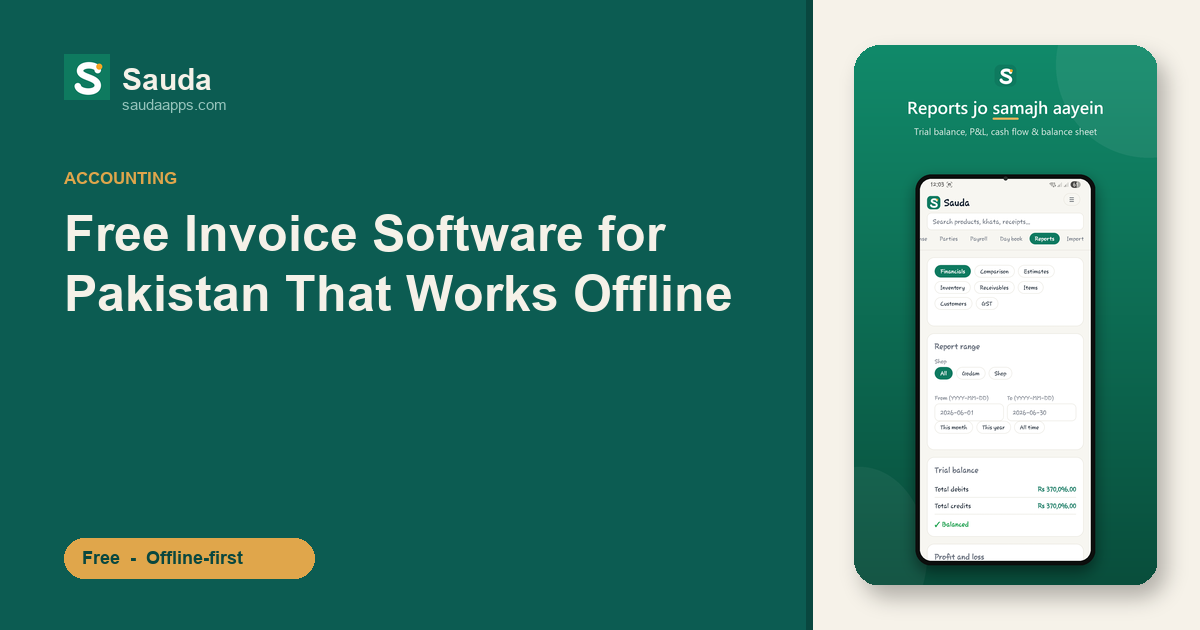
Underneath runs proper double-entry accounting, so your profit report and party balances actually tie out. You don't have to think about the accounting. It just adds up right.
More than a bill maker
The invoice is the front door. Behind it, Sauda watches the parts a growing dukan forgets about.
Your stock lives across every shop and godam in one view, with low-stock alerts before a fast line runs dry. And it flags expiry per item, ahead of time. That box of stock quietly aging on the shelf? You hear about it before it turns into dead money, which matters for a medical or general store. There's more under the hood too, from multi-shop inventory to profit reports, basic payroll for your staff, and roles so an owner, a manager, a cashier, and an accountant each see only what they should.
Tax stays off unless you switch it on. No sales-tax fields cluttering the selling screen. If you ever need optional sales-tax on a bill, it's there. Until then, the screen stays clean.
Free forever, and your data stays yours
No subscription and no card on file, so there's no "premium" wall waiting to appear after 30 days. Free means free.
Your sales, your customers, your stock. All of it lives on your device and your account, not held hostage by anyone. Curious how the offline side holds up during load-shedding? Read how Sauda works without internet.
Try it on the counter for a week during your busiest hours. If it survives your evening rush and the next power cut, you'll know.
Download Sauda free and start billing today, on your phone, your PC, or the web.