A cloth trader in Faisalabad's cloth market once showed me his bahi-khata. Three registers, rubber-banded together, ink smudged where the fan had blown rain in. He could tell you what any customer owed, as long as he had the right register, and as long as page 44 hadn't torn out. One monsoon, page 44 tore out. Rs 18,000 of udhaar, gone to memory and argument. The customer swore he'd already paid. There was no page left to prove otherwise.
That register is the thing most Pakistani shopkeepers are actually trying to replace when they go looking online. Not fancy accounting. Just a safer, searchable version of the book they already trust.
What people mean by "udhaar book"
An udhaar book is your running hisaab of who owes you and whom you owe. Customer took goods on credit today, paid half next week, you write both lines, and the balance carries forward. Lena is what you have to receive. Dena is what you have to pay. That's the whole system, and it has worked for a hundred years.
The paper version has two real weaknesses. It's one physical copy, so fire, water, or a torn page ends the record. And it doesn't add up for you. I've watched a mobile shopkeeper on Lahore's Hall Road spend the better part of half an hour hunting one regular's balance across three registers, customers waiting, while he flipped pages by memory. The register never totals itself. You do that by hand, at night, when you're tired.
A good udhaar book alternative keeps the same simple lena-dena logic but fixes those two things. It should hold every party's khata, show a clear balance, and never lose a page.
Where most apps quietly charge you
Search the Play Store and you'll find plenty of khata apps. The catch usually shows up later: the reports go grey and a little "Upgrade" tag appears the day you actually need last month's numbers. Reminders and backups slip behind a paid plan. Some push you toward loans or a wallet you never asked for. And a lot of them live only on your phone, which is fine until the phone is at home and the counter PC is where you actually do your evening hisaab.
If you're comparing options, judge them on four honest questions:
| Question | Why it matters for a dukan |
|---|---|
| Is it free forever, or just a free trial that ends? | Thin margins. A Rs 500/month app is Rs 6,000 a year, real rupay out of the till. |
| Works offline? | Load-shedding and weak signal are daily, not rare. |
| Runs on PC too, or phone only? | Evening hisaab often happens on the counter computer. |
| Is your data locked in? | If you can't leave, you don't really own your khata. |
How Sauda fits
Sauda is a free, offline-first shop app built for Pakistan. It runs on Android, on the web, and as a proper Windows desktop app for the counter PC, and it syncs between them automatically when internet comes back. Write a sale on the phone during the day, and it's on your desktop by evening.
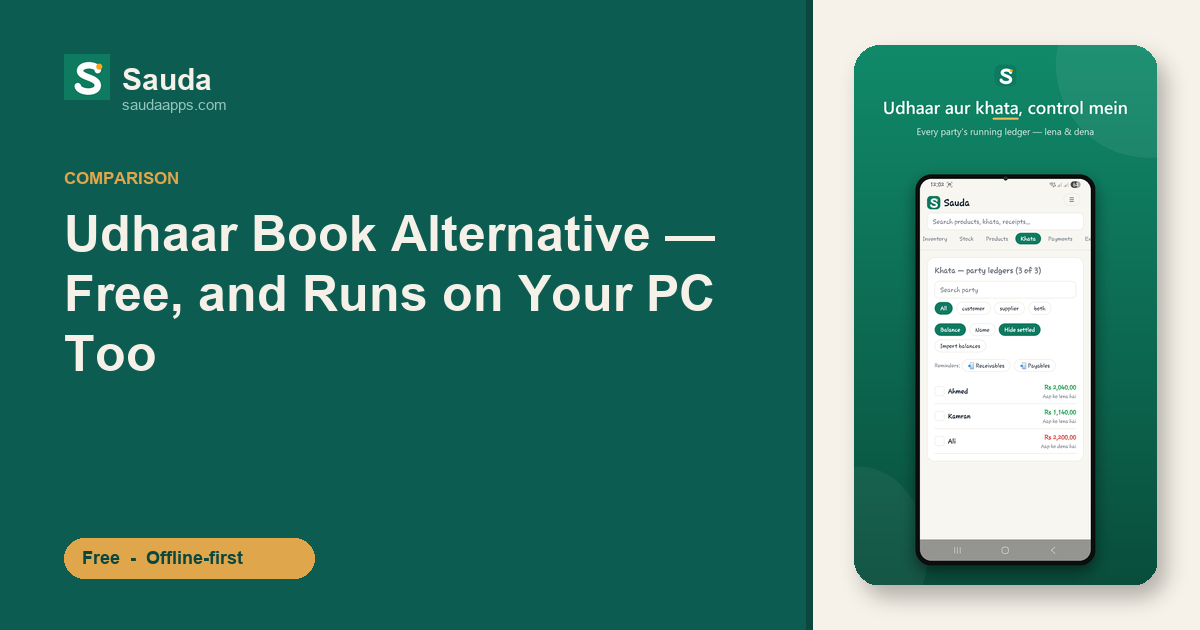
The khata part does exactly what the register did, minus the torn pages. Each party gets a running lena-dena ledger, whether they're a customer, a supplier, or both. You record udhaar and payments, and Sauda keeps the balance for you. No mental arithmetic at midnight.
It goes further than a plain khata book when you want it to. Billing at the counter, inventory across multiple shops and godams, low-stock and item-level expiry alerts, barcode scanning with automatic EAN-13 generation for blank items, a roznamcha, and profit and party reports that add up on their own because double-entry accounting runs underneath. Basic payroll and multi-user roles (owner, manager, cashier, accountant) are there when the shop grows.
Two honest limits, so you know before you download. Sauda doesn't do batch or lot tracking, and there's no pre-loaded medicine database, so a large medical store with strict batch needs should test it carefully first. And tax stays off by default, the way it should be for most counters. Optional sales-tax fields are there if you ever need them, but there's no FBR fiscalization or integration. For most karyana, hardware, cloth, mobile, and wholesale shops, none of that gets in the way.
Free forever means free. No subscription, no card, no trial clock. The interface is in Urdu and Roman-Urdu, "aap ko lena hai / dena hai", with an English toggle for whoever prefers it. If you want a second opinion before you trust it with your hisaab, ask any dukandar who already runs it, or send this to your shopkeeper group on WhatsApp and let them poke holes.
Download Sauda free and move your udhaar off paper this week. Your first party khata takes about two minutes to set up.
FAQ
Is Sauda really free, or is it a trial?
Free forever. There's no subscription and no card required. You don't unlock features by paying, and there's no clock counting down.
Does it work without internet?
Yes. Sauda is offline-first, so every sale and khata entry saves on your device immediately, then syncs to your other devices when the connection returns.
Can I use it on my shop computer, not just the phone?
Most owners keep the Windows desktop app open at the counter and glance at the phone during the day. There's also a web version, and all three sync automatically, so the same khata shows everywhere.
Will it handle a medical store's expiry dates?
It gives item-level expiry alerts, which cover most general retail. It does not do batch or lot tracking or ship a medicine database, so a large pharmacy with strict batch rules should trial it first.
Is my data locked in?
No. Your khata is yours. Sauda syncs and stores your data so you keep your records; it doesn't hold them hostage behind a paywall or push you into loans.