Ramzan Sahib runs a karyana store off Lahore's Bund Road. His udhaar register lives under the cash drawer, a fat, rubber-banded bahi-khata with 140-odd names in it. Last Eid he lost a page. Just one page. Somewhere around Rs 18,000 of lena walked out the door with it, because he couldn't remember who owed what, and he wasn't going to accuse a regular customer without proof.
That torn page is why shopkeepers go looking for a khata app. Not because they love technology. Because paper burns, tears, and gets left in the rain.
So which one is actually worth putting your hisaab into? Let me be straight with you, including about our own app.
What a khata app really needs to do
Strip away the marketing and a dukandar needs four plain things.
It has to work when the internet doesn't. Load-shedding, dead signal in a basement shop in Karachi Saddar, a data package that ran out at 11pm, the app should not freeze. Your khata is your money; it can't depend on a bar of signal.
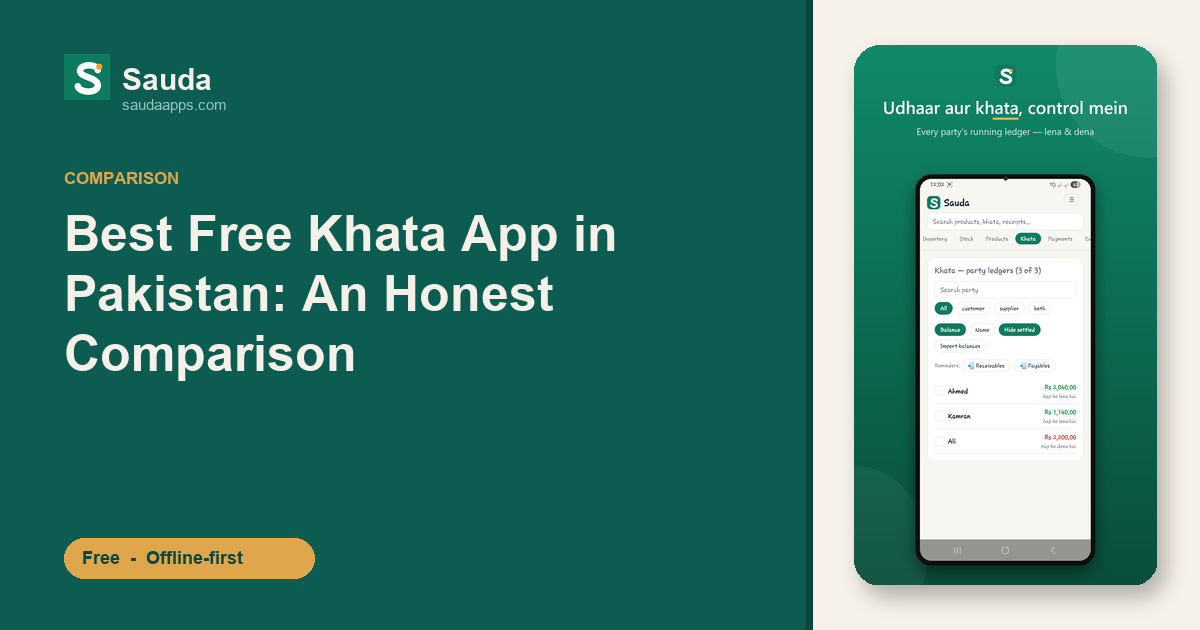
It has to track udhaar cleanly, per party, with a running balance and a WhatsApp reminder you can fire off without typing. Lena on one side, dena on the other.
It should not hold your data hostage. If the app dies or starts charging, can you get your numbers out? A lot of shopkeepers have been burned here.
And it should cost what it says. "Free" that turns into Rs 500 a month after 30 days is not free.
The honest comparison
Most "khata apps" in the market are ledger-only. They record who owes you money and that's it. That's fine if all you want is a digital bahi-khata. But if you also want billing, stock, and hisaab that ties out in one place, the picture changes.
| What you get | Plain digital khata apps | Full shop apps (billing + stock) | Sauda |
|---|---|---|---|
| Udhaar / lena-dena ledger | Yes | Usually | Yes |
| Quickest to learn | Lightest | Heavier | Heavier than a plain ledger |
| Works fully offline | Some | Often partly | Yes, offline-first |
| POS billing | Rarely | Yes | Yes |
| Inventory across shops + godam | No | Sometimes | Yes |
| Expiry + low-stock alerts | No | Sometimes | Yes, item-level |
| Hisaab barabar (accounting that ties out) | No | Sometimes | Yes, double-entry |
| Monthly fee | Often after trial | Usually | None, no card |
| Urdu / Roman-Urdu screen | Some | Some | Yes, with English toggle |
The point isn't that one type is "best" for everyone. If you genuinely only want to replace the register and nothing else, a plain ledger app is lighter to learn and quicker to set up, and there Sauda is the heavier option. The trade-off with the light app is you'll be running a second app the day you want billing or stock, and your data lives in two places.
Where Sauda fits, and where it doesn't
Sauda is a free shop app built for Pakistan. It runs on Android, on the web, and on a Windows desktop for the counter PC on Faisalabad's cloth-market kind of setup, and it syncs between them automatically once you're back online. Your khata, your bills, your stock, the same numbers on every screen.
It does the full job: POS billing, khata with udhaar reminders, inventory across multiple shops and godams, item-level expiry and low-stock alerts, barcode scanning with auto EAN-13 generation for items that came without a barcode, a roznamcha day book, profit and party reports, basic payroll, and roles for your manager, cashier, and accountant. The accounting underneath is real double-entry, so your reports actually tie out. Sales-tax fields exist but stay off unless you switch them on, and most small dukans never touch them.
Now the honest part. Sauda is not a specialist medical-store system. It has expiry alerts you set per item, but there's no pre-loaded medicine database and no batch or lot tracking, and it doesn't handle DRAP paperwork or FBR sales-tax POS rules. It's not restaurant software, no table or kitchen-order screens. Payroll is basic, not biometric attendance. And it doesn't sell any POS machine or hardware; you use the phone or PC you already have. If those specialist things are your core need, another tool may fit you better, and that's a fair call to make.
One more thing worth clearing up: this Sauda is a Pakistani app at saudaapps.com. It is not the Indian company with a similar name. Rupay yahan Rs / PKR hain, the Indian rupee has nothing to do with us.
How to actually pick
Try before you trust. Put one real day of your dukan into any app you're testing, a morning's bills, five udhaar parties, a few stock items. See if it survives a power cut and a dead signal. See if you can pull your data back out. See if the screen speaks a language your cashier reads without help.
And do what everyone in the bazaar already does: apne saath wale dukandar se poochein jo pehle se koi app chala raha hai. Word-of-mouth on WhatsApp will tell you more than any ad.
The best free khata app for you is the one your staff will actually use at 9pm when the shop is full, not the one with the prettiest ad. For most general stores, that means offline-first, no monthly fee, and everything, udhaar and billing and stock, in one book instead of three.
Try Sauda free, no card, no subscription: download it from saudaapps.com. Put one day of hisaab in and judge it yourself.
FAQ
Is Sauda really free, or does it charge later?
Free forever. No card, no auto-renew, no trial that flips into a monthly bill. Hum aap se paise nahi mangenge, and you keep your data.
Does it work without internet?
Yes. Sauda is offline-first, it writes everything to your device first and syncs automatically when you're back online. A power cut or dead signal won't stop a sale or a khata entry.
Can I send udhaar reminders to customers?
Each party has a running lena-dena balance, and you can share a reminder over WhatsApp without typing the whole message out.
Is this the same as the Indian Sauda app?
No. This is a Pakistan-only app at saudaapps.com, built for local dukans, with Urdu and Roman-Urdu screens and amounts in Rs / PKR.
Can I use it on my shop computer and my phone together?
Runs on all three, Android, web, and Windows desktop, with the same data kept in sync automatically across every device.